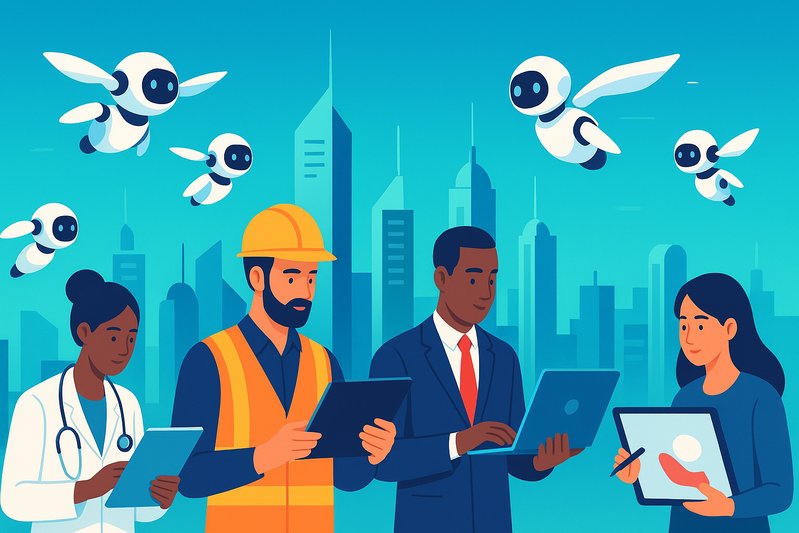
2026: The Year AI Companions Changed Industries Forever
Explore the dramatic integration of agentic AI in business and society for 2026
The year 2026 is etched in human history as a watershed moment when sci-fi speculation about artificial intelligence (AI) became our lived reality. The once far-fetched notion of agentic AI companions has leaped off the pages of science fiction and into virtually every facet of business and daily life. From enterprise workflows to creative fields, these AI entities are not just following commands but moulding the way industries function.
The Dawn of Agentic AI
Traditionally, Artificial Intelligence had its locus in theoretical possibility and lab-based experiments. However, by 2026, the barrier between AI and agentic, multimodal communication—capable of engaging with text, vision, and audio seamlessly—has vanished. The release of GPT-4o demonstrated native real-time interactions, creating a robust platform for interactive assistants in customer support, creative workflows, and more. Key to this revolution is not just the technological advancement but also regulatory frameworks like NIST’s AI Risk Management Framework (AI RMF) and the EU’s AI Act, which provide much-needed governance towards standardization and accountability.
Real-World Traction and Industry Transformation
The most evident change in industry usage is the speed and depth with which AI has penetrated tasks that require nuanced understanding and adaptation. An example can be seen in the logistical space, where platforms like Zipline have employed AI-driven operations for high-frequency deliveries across continents. This isn’t tech proof-of-concept anymore—it’s a daily occurrence supported by regulatory approvals for operations beyond visual line of sight (BVLOS).
NVIDIA’s contribution with robotics and simulation platforms means a lowered barrier to entry for developing and integrating autonomous solutions. This reflects an industry’s striving towards scalability in complex environments like warehouses and delivery systems, though tasks outside controlled settings still pose tangible challenges.
The Sci-Fi Driven Inspiration
The migration from speculative fiction to tangible solutions is perhaps the most exciting narrative. Consider xAI’s branding of “Grok,” plucked directly from Heinlein’s canonical works. Such cultural tangents not only reinforce AI’s place in our psyche but also show direct influence from literary history on technological branding. Similarly, Pixar’s scene description technology USD evolving into OpenUSD and serving as multi-industry infrastructure distributes sci-fi imagination into our practical realities.
Challenges: The Path Isn’t Without Hurdles
While agentic AI is stabilizing and offering real-world benefits, challenges remain manifold. Open-ended AI agents grapple with issues of ethical use and safety, while humanoid robotics continue to seek breakthroughs in dexterity and reliable operations. Established frameworks like the EU AI Act impose stringent conformity assessments, requiring deeply integrated documentation processes for high-risk systems. Meanwhile, the United States emphasizes sectoral guidance while avoiding excessive regulatory control, maintaining a balance with incentives and contemporary policies.
Global Variability and Implementation Tactics
Global governance starkly affects implementation timelines and acceptance. Europe’s stringent regulatory approach contrasts with the more flexible, innovation-sparking regimes seen in certain APAC locations with bespoke frameworks, enabling unique city-scale autonomy projects. Each region’s approach informs how industries like biotechnology—examining gene-editing therapies reaching patients—cope with these global landscapes.
Cultivated meats also witness regulatory-varied acceptance. The USDA approved these products, leading to their controlled commercialization with safety checks and robust labeling practices—mirroring science fiction scenarios where engineered foods become a part of everyday consumption.
Conclusion: Key Takeaways to Shape the Future
The integration and transformation seen in 2026 highlight AI’s trajectory from speculative sci-fi imaginings to foundational industry mechanisms. This year signals a definitive pivot to a normalized existence of AI companions reshaping how business sectors operate, anchored tightly by a lattice of stringent governance and cultural synergy.
The interplay between regions, compliance frameworks, and industry-specific challenges carves a nuanced path forward for AI progression. What’s unmistakably clear is the indispensable need for cross-sectoral collaboration, integrating inputs from vivid sci-fi speculation and regulatory expertise to advance the global omnipresence of AI systems.
Welcome to a new era—not of isolated human intelligence but rather a dynamic partnership with machine-driven companions, crafting a world where AI sees, hears, listens, and grows with us.