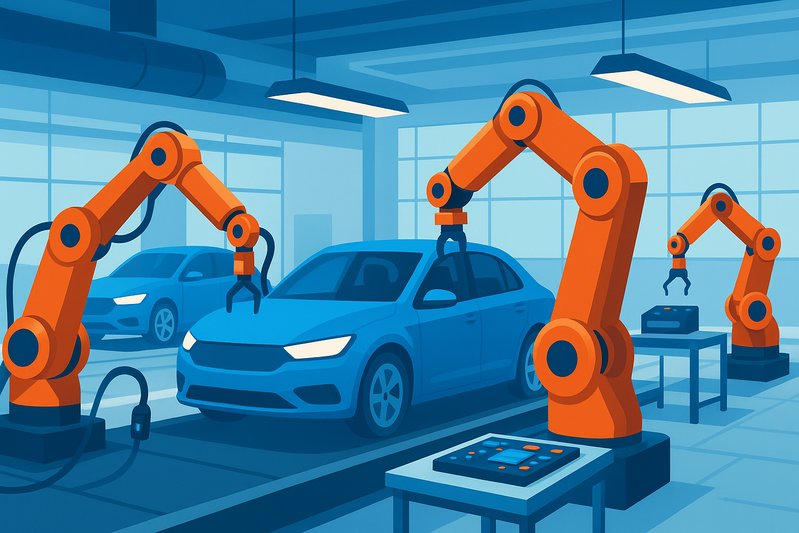
A Surge in Industrial Robotics: Redefining Global Manufacturing
How industrial robots are boosting automation in rapidly evolving sectors like automotive and electronics
In the rapidly evolving landscape of industrial manufacturing, the adoption of robotics technology is reshaping the global production ecosystem. By 2026, industrial robots are expected to have transformed sectors such as automotive and electronics, achieving new milestones in efficiency, speed, and precision [1]. This renewed momentum stems from the technological advancements and economic shifts reconfiguring manufacturing processes worldwide.
The Rise of Industrial Robots
Setting New Global Peaks
Industrial robot installations reached unprecedented levels in 2022, with Asia leading the charge. This growth was particularly evident in China, the world’s largest single-country consumer of industrial robots. The surge in demand has been fueled by the country’s robust electronic and electric vehicle (EV) industries, which are spearheading efforts to modernize production lines with state-of-the-art robotics [2].
Notably, the North American market, which experienced a brief slump in 2023 due to sector-specific pauses in automotive and electronics, is projected to recover by 2025. This rebound is attributed to renewed investments in electric vehicles, battery production, and electronics, coupled with reshoring initiatives intended to enhance production capabilities [3].
Cobots: Flexible Allies in Automation
Collaborative robots, or cobots, are gaining traction as they integrate more seamlessly into human workspaces. With superior safety features and ease of use, SMEs are adopting cobots for tasks such as machine tending, assembly, and palletizing. Universal Robots continues to be a dominant force in this category, credited with a significant installed base and a rich ecosystem of application kits [8]. Cobots offer not just operational flexibility but also scalability through software and accessory integration.
Innovations in Logistics and AMRs
The logistics and warehouse sectors are experiencing an automation boom, driven largely by Autonomous Mobile Robots (AMRs). These robots are central to improving intralogistics workflows, from goods-to-person systems to case and pallet handling operations. By 2026, safety standards (like ISO 3691-4) and emerging technological advancements in perception and fleet orchestration will further accelerate AMR adoption [23]. This includes a shift towards Robotics-as-a-Service (RaaS) models that align operational costs with throughput, providing attractive ROI for businesses [25].
Impacts on Automotive and Electronics Sectors
Automotive Industry Revitalization
The automotive industry, a traditional stronghold of industrial robotics, is undergoing a significant transition amid the rise of electric vehicles. Industrial robots are enhancing the capacity for mass customization, allowing manufacturers to swiftly pivot production lines to accommodate new models. As EV demand grows, robots are playing a crucial role in assembling delicate components like battery modules, prioritizing precision and speed.
Electronics Manufacturing Transformation
In the electronics sector, the push towards miniaturization and increasingly complex assembly processes has led to a greater reliance on robotics. Manufacturers are adopting robots not only to maintain precision in complex tasks but also to address labor shortages and quality consistency issues. These trends are driving investments in advanced robotics systems able to handle intricate assembly tasks, supported by integrated vision and safety features.
Conclusion: The Future of Industrial Robotics
The adoption of industrial robotics is more than just a response to current economic pressures; it is a cornerstone of future-proof manufacturing strategies. With continuous improvements in software, perception, and integration standards, industrial robots are set to become even more integral to global manufacturing processes.
Looking forward, manufacturers must navigate regulatory landscapes like the EU AI Act and U.S. export controls, which will impact supply chains and market access in strategic ways [27]. As these industries continue to evolve, robotics will undoubtedly play a crucial role in maintaining competitiveness and innovation.
In conclusion, the widespread adoption of industrial robotics in manufacturing is not merely a trend but a substantial shift towards a more automated, efficient, and sustainable production landscape. The advancements witnessed in the automotive and electronics sectors provide a preview of what the future holds as industrial robots continue to redefine global manufacturing.