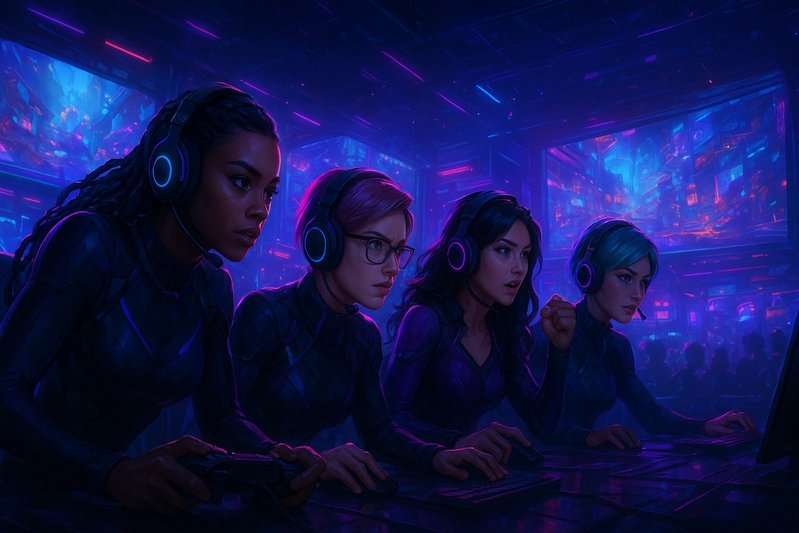
Breaking Barriers: The Evolution of Women’s Esports
From Pilot Programs to Premier Competitive Platforms
In the dynamic realm of esports, an arena traditionally dominated by male participation and viewership, women have often faced barriers that hampered their involvement. Yet, the past few years have heralded a revolutionary shift, turning women’s esports from mere pilot programs to recognized properties, forging a path to equality in competitive gaming. This article delves into the growth and development of women’s esports, capturing its current landscape and peeking into its future.
The Global Esports Tapestry
To understand the momentum behind women’s esports, one needs to appreciate the broader global esports context. As of 2026, the esports industry stands as a culturally powerful yet structurally diverse segment. Its monetary value, while burgeoning, is concentrated in regions like Southeast Asia (SEA), the Middle East and North Africa (MENA), and Latin America (LATAM). These areas are at the forefront, driven by a mobile-first ecosystem revolution that democratizes access to gaming content. Platforms such as Twitch and YouTube Gaming capture vast swathes of audience attention, while TikTok Live complements this ecosystem with co-streaming capabilities and e-commerce integrations.
Women’s Esports Ascension
Women’s participation in esports has moved beyond niche pilot programs into formidable competitive platforms. A pivotal point was the Valorant Game Changers Championship in 2023, which peaked with viewership of around 230,000 (excluding China). This event underscored the untapped demand when a blend of production values, compelling storylines, and strategic co-streaming was brought into play. Complementing this, ESL Impact elevated women’s Counter-Strike (CS) into global circuits, embedding LAN finals within major festivals and fostering dedicated sponsorships and talent pipelines.
Partnership Models and Open Circuits
The structured rise of women’s esports cannot be discussed without recognizing the different operational frameworks shaping the broader industry. On one end of the spectrum, partnership-led leagues—such as those run by Riot Games for League of Legends (LoL) and Valorant—offer stability and brand control, employing revenue-sharing to sustain team viability. On the other hand, Valve’s open circuit model for Dota 2 and CS2 allows greater creative freedom and innovation by external organizers. Women’s esports, notably, has benefited from both models by leveraging curated partnerships for visibility and open circuits for broad participation opportunities.
Regional Variations: Growth Engines and Hurdles
While North American and European leagues have restructured for sustainability, regions like SEA, MENA, and LATAM are witnessing explosive growth. These areas not only lead in mobile esports but are also redefining participation demographics. Mobile Legends: Bang Bang (MLBB) dominates Southeast Asia, supported by thriving Mobile Premier Leagues (MPLs) and multilingual productions. Meanwhile, in India and MENA, the demand is significant, though tempered by regulatory fluctuations.
Japan and Korea maintain strong esports cultures, contributing to global standards of quality and integrity. A crucial element aiding women’s esports is the targeted initiatives within these regions to ensure inclusivity, resulting in increasing female participation and viewership—particularly in mobile-first gaming ecosystems.
Leveraging Digital Innovations
As digital transformations redefine esports, women’s competitions are harnessing these advancements to scale and engage global audiences. Co-streaming has become a powerful tool, multiplying audience reach through creator-driven channels on Twitch and YouTube. Moreover, the integration of in-stream commerce and interactive features—such as those on TikTok Live—enhances monetization avenues, aligning audience engagement with commercial value to create a supportive financial ecosystem for women’s leagues.
Challenges, Risks, and Future Trajectories
Despite the progress, women’s esports still faces challenges: achieving profitability amid high operational costs, managing regulatory risks, and addressing player health—and burnout—due to dense schedules. Teams are pivoting toward sustainable business models, balancing competitive participation with direct-to-consumer digital revenue streams and creator-commerce ecosystems.
Looking ahead to 2030, women’s esports is poised to transition from supportive programs to cornerstone properties of the esports landscape. The maturation of women’s circuits with consistent calendars and dedicated sponsorships signals a future where mixed-gender integrations become mainstream, reinforcing esports as a truly inclusive environment.
Conclusion: The Way Forward
The evolution of women’s esports is a critical chapter in the broader esports narrative, reflecting the industry’s ability to innovate and embrace inclusivity. It showcases that when given the platform, women can compete with the highest caliber, fostering diversity audiences crave. As women’s esports continues to break barriers and as global ecosystems support its rise, the scene becomes a beacon of opportunity and growth, underscoring esports’ transformative power within entertainment.
By aligning growth strategies with sustainable practices and leveraging technological advancements, the industry can enhance its appeal and expand its reach—ensuring that esports, regardless of gender, remains an arena for all.