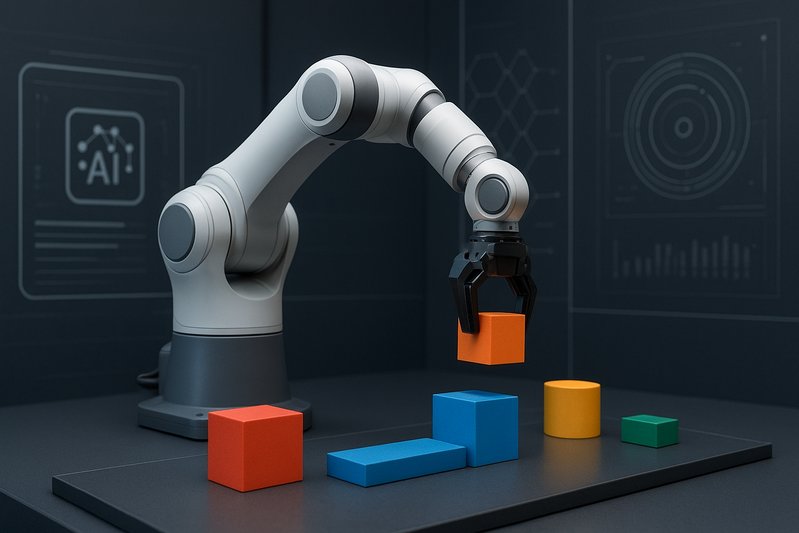
Empowering Industry: The Robotic Revolution in Mobile Manipulation
Subtitle: How AI and robotics are transforming automation in industrial settings
The industrial landscape is undergoing a seismic shift, as advancements in robotics and artificial intelligence drive a new era of automation. At the forefront of this transformation is mobile manipulation—a field poised to revolutionize how industries handle tasks ranging from material handling to complex manufacturing operations. By leveraging cutting-edge technologies such as multimodal perception, digital twins, and end-to-end learning models, mobile manipulation is setting new standards for efficiency and safety in industrial environments.
The Rise of Mobile Manipulation
In recent years, robotics has expanded from static, isolated roles to more dynamic, integrated functions. Mobile manipulation represents the synergy of mobility and dexterity, enabling robots to perform complex tasks across varied environments. As detailed in the research report “Autonomous Systems in 2026,” mobile manipulation is being driven by robotics foundation models trained on diverse data and enhanced by digital twins that bridge the gap between simulation and real-world application.
The development of high-dexterity, all-electric robots—such as Boston Dynamics’ next-generation Atlas—has shifted the industry’s focus from acrobatic feats to tangible industrial benefits. These advancements are supported by safety-aware control stacks and digital twin technologies that allow for precise planning and risk mitigation before field deployment.
Cutting-Edge Technologies Transforming Robotics
Multimodal Perception and AI Integration
Mobile manipulation is significantly benefiting from sophisticated AI models, such as the RT-2, which integrate language-conditioned perception with action execution. This allows robots to adapt to complex, dynamic scenarios using vision-language-action (VLA) policies. Open-X-Embodiment and OpenVLA datasets further enhance these capabilities by promoting cross-task generalization across different robot embodiments.
Digital Twins and Sim-to-Real Transfers
Digital twins are indispensable in developing and testing robotic systems in virtual environments. Platforms like NVIDIA’s Isaac Sim utilize photorealistic rendering and precise physics to close the sim-to-real gap. This allows developers to iterate designs rapidly and perform regression testing in simulated long-tail scenarios before actual deployment.
In a real-world context, these digital tools assist in ensuring that robots can execute tasks with high accuracy and reliability. This capability is crucial for industrial settings where safety and efficiency are paramount.
Real-World Applications and Business Impact
Industrial and Logistics Deployment
Mobile manipulation robots are increasingly being deployed in manufacturing and logistics settings, where they handle repetitive tasks that require a blend of mobility and precision. For instance, Agility Robotics’ Digit humanoid robots are being piloted in material handling and inspection roles, significantly enhancing operational uptime and reducing variability in cycle times.
Similarly, Boston Dynamics has successfully scaled its Spot robot fleets for industrial inspection, demonstrating a clear ROI through reduced human entry into confined spaces and improved predictive maintenance outcomes.
The Role of Edge Computing and AI Integration
The success of these robotic systems heavily relies on powerful edge computing platforms like NVIDIA’s Jetson Thor, which provide the necessary processing power for real-time perception and decision-making. These systems ensure that robots can operate autonomously with high efficiency while maintaining the stringent safety standards required in industrial environments.
Navigating Challenges and Opportunities
Despite these advancements, challenges remain. Ensuring statistically significant safety over human baselines in open-world environments is complex. Regulatory landscapes and safety certifications, such as those outlined in ISO 26262 and UL 4600, require continuous alignment and engagement to bridge gaps between innovation and safety assurance.
Additionally, energy efficiency and sustainability considerations are gaining prominence as the environmental footprints of robotic systems, including compute energy and lifecycle implications, come under scrutiny.
Future Implications and Strategic Considerations
Looking ahead to 2030, the adoption of mobile manipulation systems is expected to concentrate in sectors where operational complexity is managed and clear economic benefits exist, such as middle-mile trucking, facility inspection, and structured airspaces for drone delivery. The integration of VLA models and digital twin technologies is crucial in pushing the boundaries of automation in these applications.
Regulatory development, particularly in BVLOS frameworks for drones and ADS-in-CMV rules for autonomous trucking, will play a significant role in scaling these solutions. This regulatory evolution necessitates active collaboration with authorities and adaptation to emerging standards to ensure seamless deployment.
Conclusion
The robotic revolution in mobile manipulation promises to unlock unprecedented levels of efficiency and safety across industrial domains. As AI and robotics continue to evolve, industries must embrace these technologies, leveraging their potential to redefine production and logistics processes. The future of industrial automation is here, and those who adapt swiftly will reap the benefits of a truly transformative robotic era.