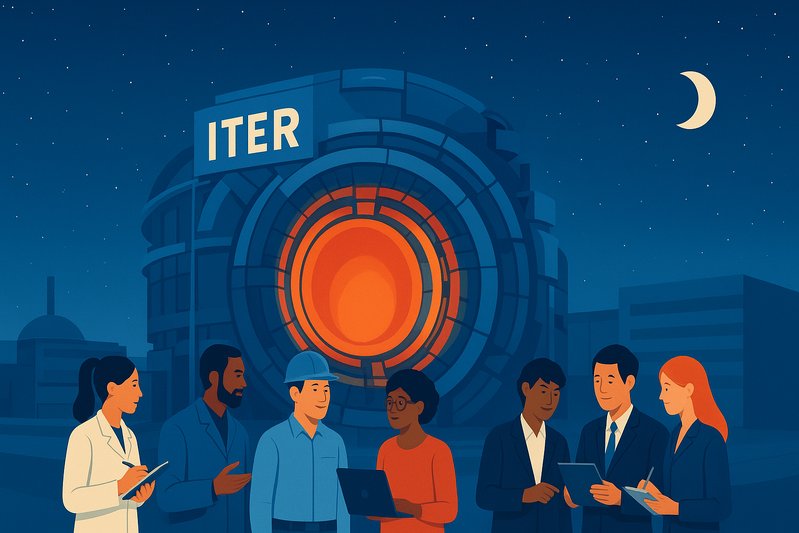
Inside ITER: Global Collaboration in Nuclear Fusion
How Multinational Partnerships Are Shaping the Future of Fusion Technology
In the quest for a sustainable, virtually limitless energy source, nuclear fusion stands as a beacon of hope. Yet, the challenge of harnessing fusion power is monumental, requiring not just technological breakthroughs but also unprecedented global cooperation. At the heart of these efforts is the International Thermonuclear Experimental Reactor (ITER), an ambitious scientific endeavor that epitomizes the spirit of international collaboration.
The Vision of ITER
Located in southern France, ITER is the world’s largest nuclear fusion project, representing not just a scientific triumph but a diplomatic one. It brings together seven major entities: the European Union, United States, China, India, Japan, South Korea, and Russia. Each member contributes parts, knowledge, and resources under a binding international treaty, coordinated through a Council-led governance structure [1][2].
The project’s primary aim is to demonstrate the viability of fusion as a large-scale and carbon-neutral source of energy. Unlike fission, which powers existing nuclear plants, fusion promises more energy and cleaner waste. However, achieving this involves creating and maintaining plasma hotter than the sun’s core—a task ITER is methodically tackling with its experimental reactor.
A Synchronization of Global Efforts
The Backbone of Collaboration
The ITER initiative highlights the importance of open scientific collaboration across borders, a model currently mirrored in various nuclear fusion projects worldwide. It relies on contributions flowing through Domestic Agencies, with each member nation overseeing specific components and systems of the project [1][3]. Through this intricate meshwork, ITER integrates the global physics, engineering, and industrial efforts, synchronizing them towards a singular goal [4].
Leveraging Technology for Advanced Control
ITER’s control systems demonstrate a unique blend of international technological prowess. Leveraging the CODAC Core System, which operates on the EPICS open-source controls stack, ITER sets a global standard for plant-wide integration [4]. This system not only ensures efficient management of the reactor’s complex operations but also influences practices and integration strategies among its global suppliers.
Data Sharing and Open Science
Open technology plays a pivotal role in the project’s collaborative efforts. The International Tokamak Physics Activity (ITPA), a community initiative under ITER, coordinates research priorities and manages shared databases across the member nations [3]. This open scientific platform enables the collaboration necessary for advancing fusion research on a global scale.
Global Support Beyond ITER
While ITER stands at the forefront, it is not alone. The broader global landscape for fusion energy research involves significant programs that complement and feed into ITER’s mission.
Diverse International Programs
Outside of ITER, other countries spearhead significant fusion projects. In the United States, the Department of Energy’s Fusion Energy Sciences orchestrates a network of national labs and user facilities that support both public science efforts and private sector developments [27]. Meanwhile, EUROfusion continues to coordinate European efforts, aligning university and laboratory networks under strategic governance to push forward fusion research [5].
Public-Private Partnerships
In the UK, the Spherical Tokamak for Energy Production (STEP) program, managed by the UK Atomic Energy Authority, furthers the nation’s fusion agenda by integrating government policy with industry engagement, illustrating a comprehensive approach to fusion research [10]. Similarly, the U.S. supports fusion development through milestone-based programs that align public resources with private sector innovations [28].
Industry Driving Innovation
Private companies also play a crucial role, with firms like Commonwealth Fusion Systems and TAE Technologies pushing the boundaries of compact high-field machines and field-reversed configurations, respectively. Their advancements in high-temperature superconductors and plasma control are essential steps toward making fusion commercially viable [32][35].
Regulatory Procedures and Safety
An essential piece of the fusion energy puzzle lies in regulatory frameworks that ensure safe development and operation. Recent efforts by OECD’s Nuclear Energy Agency and the International Atomic Energy Agency help standardize safety norms tailored specifically to the needs of fusion reactors, distinguishing them from traditional nuclear fission safety requirements [26]. This global regulatory alignment is crucial for reducing barriers to constructing and operating new fusion plants.
The Road Ahead for Fusion Technology
As ITER progresses towards achieving its first plasma, the project remains a testament to the potential of collaborative scientific endeavor transcending national boundaries. The project’s milestones, alongside parallel international efforts, show potential pathways to overcoming the daunting technical challenges that lie ahead.
While the road to a commercially viable fusion power plant is long and fraught with challenges, the combined effort of nations working through ITER provides a tangible framework for advancement. The collaborations fostered here extend beyond science; they build international relationships based on mutual goals and shared progress.
In conclusion, the future of fusion energy is as bright as the millions of degrees needed to sustain fusion. ITER and its associated international cooperative networks represent a beacon of hope and a model for addressing global challenges through shared knowledge, open collaboration, and a unified vision for the energy needs of future generations.