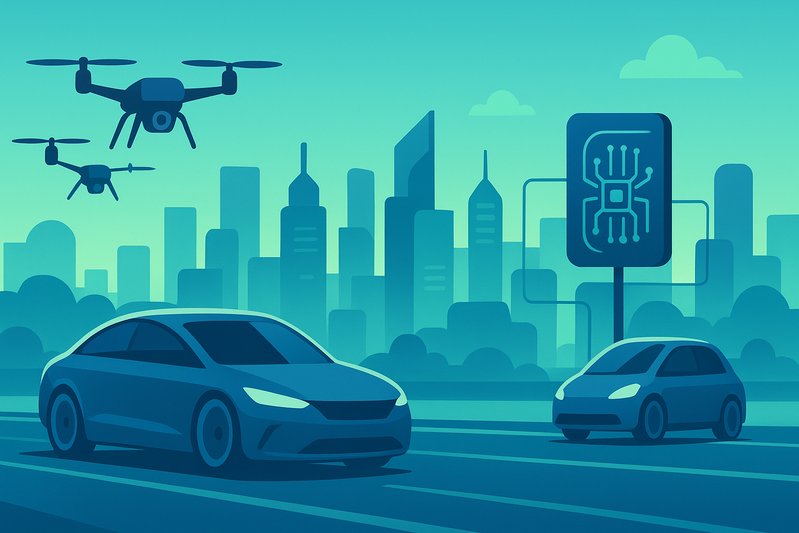
Intelligent Hardware: The Role of Edge Computing and Accelerators in Autonomous Systems
Exploring the impact of advanced computing on the efficiency and safety of autonomy
In the realm of autonomous systems, the marriage of cutting-edge technology with high-stakes operational demands has sparked transformative innovations. This convergence has propelled advancements, particularly in edge computing and hardware accelerators, becoming pivotal in enhancing the safety and efficiency of autonomous operations. As we steer into 2026, understanding these technological enablers gives us a glimpse into the implications for a future teeming with intelligent machines.
The Engine Behind Autonomous Systems
Autonomous systems encompass diverse sectors—from road vehicles and drones to maritime vessels and industrial robots. Central to these systems is the ability to process vast quantities of data quickly and efficiently, a capability significantly bolstered by edge computing and hardware accelerators.
Edge Computing: The Brain at the Edge
Edge computing has revolutionized the landscape of autonomous operations by enabling data processing closer to data sources. This localization reduces latency, enhances data privacy, and increases reliability—all crucial for mission-critical applications. NVIDIA’s Jetson Thor device epitomizes this shift, offering heterogeneous acceleration for perception, planning, and decision-making processes right at the edge. Its architecture emphasizes efficiency, facilitating high-performance tasks within stringent power and thermal envelopes, ideal for autonomous vehicles navigating complex urban environments.
However, edge computing is not alone in this endeavor. The Blackwell GPU architecture by NVIDIA further elevates performance metrics, providing both the muscle for intensive computational tasks and the finesse for training and simulation workloads that underpin robust autonomous behaviors.
Hardware Accelerators: Speed Meets Precision
Equally transformative are hardware accelerators like Qualcomm’s Snapdragon Ride Flex and Mobileye’s EyeQ Ultra. These accelerators ensure that autonomous systems can safely manage the computational demands of real-time operations while adhering to functional safety standards. Integrated with safety islands and memory protection, these systems exemplify the harmonization of speed and safety, crucial for applications like advanced driver-assistance systems (ADAS) and fully autonomous vehicles (AVs).
Multimodal Perception and Sensor Fusion
A cornerstone in autonomous innovation is multimodal perception, where learning-based fusion of data from various sensors creates a robust understanding of the environment. For example, road vehicles use lidar, radar, and camera feeds to generate accurate occupancy maps, enhancing situational awareness and interaction within dynamic environments.
Beyond roadways, drones and maritime vehicles benefit from sensor synergy as they navigate multifaceted terrains. The Skydio X10 drone integrates high-fidelity sensors with onboard AI, proving invaluable in industrial inspections and mapping tasks where precision and reliability are non-negotiable.
Simulation and Digital Twins: The New Testing Ground
Remember when testing a new vehicle model meant breaking a few prototypes? Digital twins have changed the game. By simulating complex and diverse scenarios, platforms like NVIDIA’s Isaac Sim offer a digital canvas where policies and protocols are rigorously tested against long-tail challenges. This approach not only accelerates development cycles but also saves costs and resources, enabling improvements in real-world reliability.
Standards and Regulations: Safety First
As autonomous systems inch towards everyday ubiquity, regulatory bodies play a crucial role in setting the pace. The EU AI Act, with its forthcoming mandates, seeks to enforce systemic risk management and transparency measures across high-risk systems, impacting everything from automotive AI to drone airspace management.
Stateside, the FAA Reauthorization Act of 2024 shifts the landscape for Beyond Visual Line of Sight (BVLOS) operations in the UAS domain, promising to unravel operational bottlenecks and facilitate broader acceptance and deployment.
Real-World Impact and Future Directions
Real-world applications of these technologies vividly illustrate their potential. Waymo’s driverless services in complex urban zones exemplify the integration of multimodal perception with robust planning frameworks, resulting in human-comparable safety metrics [3, 4]. Similarly, in the realm of logistics, companies like Zipline are redefining delivery paradigms with their precision-engineered autonomous systems, demonstrating the tangible benefits of advanced edge computations [26].
Challenges and Considerations
Despite these advancements, challenges persist. Ensuring security across cyber-physical landscapes remains a priority, as highlighted by contemporary regulations [39]. Furthermore, the scalability of operations faces hurdles concerning infrastructure and societal acceptance, particularly in dense urban centers.
Conclusion: A Roadmap to 2030
As we look towards 2030, the role of intelligent hardware in autonomous systems will likely expand further, driven by advances in edge computing and hardware accelerators. This trajectory promises not only enhanced safety and operational efficiency but also a reshaping of industries reliant on autonomous technologies. For stakeholders—from developers to policymakers—the key lies in fostering innovation while rigorously addressing the intertwined challenges of security, regulatory compliance, and societal integration.
Autonomous systems are poised to redefine the fabric of our daily lives, driven by the silent yet powerful engines of intelligent hardware. As infrastructures evolve to accommodate these capabilities, the harmonization of technology and regulation will chart the path forward, ensuring that the future of autonomy is not just smart, but safe and sustainable.