Mechanized Marvels: The Rise of Autonomous Industrial Robotics
How Mobile Manipulation and Digital Twins Revolutionize Manufacturing
In the bustling heart of modern factories, a silent revolution is underway. Autonomous robots equipped with cutting-edge technology are transforming the way we manufacture goods. From enhancing efficiency to increasing flexibility and safety, the rise of autonomous mobile manipulators and digital twin simulations marks a new era in industrial robotics. As these technologies mature, they promise to reshape industries by merging the physical and digital worlds, providing unprecedented capabilities in automation.
Understanding Mobile Manipulation in Modern Industry
The Power of Mobile Manipulators
By 2026, the evolution of mobile manipulation is driven by sophisticated robotics foundation models and the extensive use of digital twins. The integration of language-conditioned perception and action models facilitates seamless operations in real-world environments, as demonstrated by Google’s Open-X-Embodiment project, which promotes cross-robot generalization through multi-embodiment data [28, 29].
Industrially, platforms like Boston Dynamics’ electric Atlas and Agility Robotics’ Digit have transformed from research prototypes into viable industrial solutions [50]. These robots excel in tasks such as material handling and inspection within semi-structured environments, where reliability and human-robot collaborative safety significantly affect return on investment.
Digital Twins: Bridging the Simulation-Real Gap
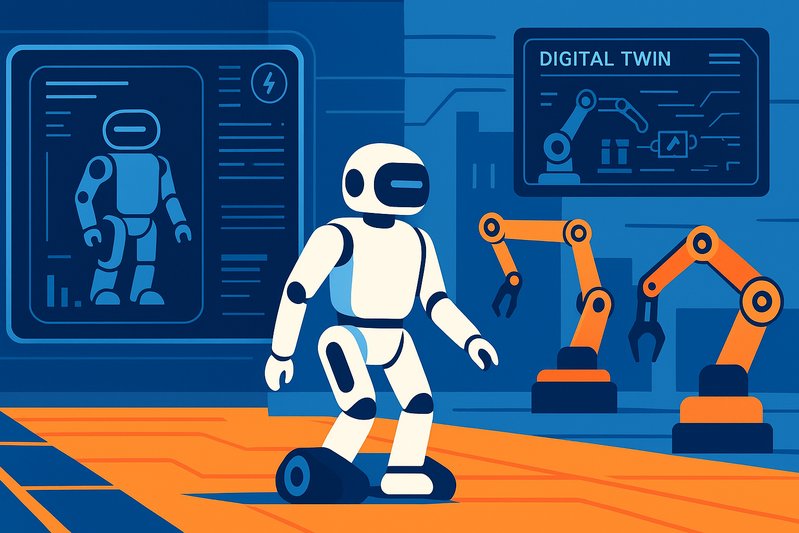
NVIDIA’s Isaac Sim stands at the forefront of digital twin technology, providing a realistic simulation environment that bridges the gap between virtual models and their real-world counterparts [33]. This photorealistic rendering platform allows developers to expose robotic systems to diverse scenarios, enhancing their ability to handle long-tail and edge cases before field deployment.
Digital twins have become essential tools, enabling companies to conduct closed-loop evaluations that reduce development time and cost. They facilitate a sim-to-real transfer by providing highly detailed environments for regression testing in varied operational design domains (ODDs).
The Role of Innovations in Robotics
Foundation Models and Safety
The robotics field has witnessed the emergence of foundation models capable of transferring learned behaviors across different robots and tasks. RT-2 and OpenVLA are prime examples of advancements that enable robots to understand and act upon language-grounded instructions in real-time [28, 30]. Such capabilities promote a generalized understanding among robots, pushing the boundaries of task execution flexibility and efficiency.
Despite these advancements, integrating safety remains a priority. Control barrier functions and reachability analyses are necessary to enforce runtime safety margins [8]. Regulatory standards, such as the UL 4600, help in establishing comprehensive safety cases, ensuring these smart machines operate with minimal risk to humans and infrastructure [13].
Hardware Advancements: The Backbone of Autonomy
Progress in hardware acceleration has been pivotal for the effective deployment of autonomous robotics. High-efficiency systems like NVIDIA’s Jetson Thor and Qualcomm’s Snapdragon Ride Flex enable sophisticated algorithms to run efficiently on edge devices, delivering high-performance results with low power consumption [34, 36]. These platforms provide the computational power necessary for advanced perception and planning tasks, essential for the next-generation industrial automation.
Real-World Deployments and Regulatory Landscapes
Success in Manufacturing and Logistics
Autonomous mobile manipulators have found success in manufacturing environments, enhancing productivity through automated tote transfers and inspection tasks [50]. Pilot projects in material handling have demonstrated significant gains in cycle-time reduction and uptime reliability, emphasizing the importance of integrating these systems into current industrial processes.
Navigating the Regulatory Environment
Global regulatory frameworks, such as the EU AI Act and U.S. FAA Reauthorization, are evolving to accommodate the growth of autonomous systems [21, 38]. These frameworks aim to ensure that the deployment of autonomous robots is safe, efficient, and regulated. They address potential risks and stipulate compliance measures necessary for widespread adoption.
The U.S. FMCSA’s ongoing ADS-in-CMV rulemaking process highlights the increasing regulatory attention on safe integration of autonomous systems in commercial settings, ensuring that critical safety and operational guidelines are met [7].
Key Challenges and Future Implications
Overcoming Hurdles
Despite significant advancements, the path to widespread adoption is not without challenges. Addressing statistical safety and reliability under open-world uncertainties remains a formidable task [6]. Additionally, the allocation of liability in the event of autonomous system failures continues to pose legal and operational questions.
A Look Towards the Future
Looking beyond 2026, the transformative impact of autonomous industrial robotics will likely center on domains with clearly defined ODDs and strong economic incentives. The middle-mile freight industry, warehouse automation, and regulated airspace UAS operations are poised for significant growth [19, 21].
As these technologies evolve, future innovations will focus on enhancing the reliability of VLA policies, integrating multi-agent coordination, and ensuring energy-efficient operations [28, 30]. Continuous improvement and adaptive learning within secure operational frameworks will be central to achieving sustainable growth.
Conclusion
The rise of autonomous industrial robotics, powered by mobile manipulation and digital twin simulations, heralds a new era of efficiency and innovation in manufacturing. By merging complex technologies with robust regulatory support, these mechanized marvels not only promise to streamline operations but also pave the way for a new industrial revolution. As industries adapt to these changes, the future of manufacturing looks set to be more dynamic, safer, and uniquely intertwined with the digital world.