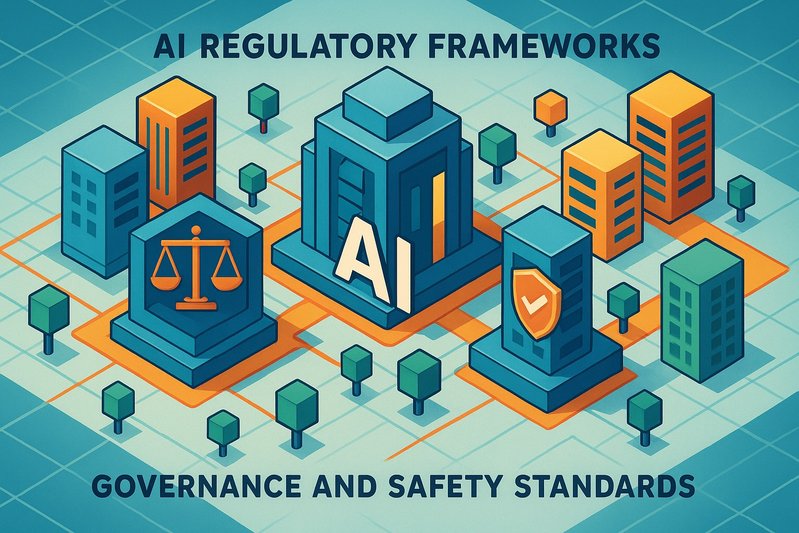
Navigating the Complexities of AI Governance: Setting New Safety Standards
How Global Regulatory Regimes Are Shaping AI Development and Deployment Standards
The rapid acceleration in artificial intelligence (AI) capabilities has created a pressing need for structured governance and safety measures. As we move further into the 2020s, the field of AI safety—a once scattershot discipline—is evolving into a cohesive and structured body of practices that span technical, socio-technical, and governance domains. The next few years are critical for determining if current and emerging frameworks can keep pace with AI’s expanding capabilities.
The Current State of AI Safety
Between 2023 and 2026, AI safety practices matured significantly. Organizations have increasingly adopted risk management frameworks and structured assurance practices. The U.S. National Institute of Standards and Technology (NIST) has been at the forefront with its AI Risk Management Framework (AI RMF), which provides a common vocabulary and process for managing risks. This framework is complemented by management-system standards like ISO/IEC 42001, aimed at institutionalizing governance and accountability.
Technical Safety Advances
In the technical realm, innovative advances have been made in mechanistic interpretability, scalable oversight, and red-teaming methodologies. Techniques like red-teaming, rooted in established threat modeling practices such as MITRE ATLAS, have become essential. Red-teaming involves rigorous methods for planning and executing tests, crucial for pre-deployment model evaluation and ensuring robust defense against adversarial threats.
Socio-Technical Safety Measures
Safety measures are not limited to technology alone. Human factors are now significantly integrated into safety cases, with contextual impact assessments that require oversight for sensitive actions. Documentation via system and model cards is becoming standard practice among frontier AI labs. These cards detail training data practices, safety evaluations, mitigations, and residual risks, providing a comprehensive overview of each model’s capabilities and limitations.
Governance Across Key Global Players
United States
In the U.S., Executive Order 14110 has catalyzed the federal push for AI governance, leading to the establishment of the U.S. AI Safety Institute by NIST. This initiative aims to develop test methods and convene key stakeholders on AI safety. This framework sets a precedent for systematic pre-deployment evaluations and conformity assessments that align with federal guidelines.
European Union
The EU has enacted the AI Act, which creates a tiered structure imposing duties on high-risk and general-purpose AI systems. This act specifically targets systemic-risk models with requirements for risk management, transparency, and post-market monitoring. The EU AI Office has been established to coordinate the enforcement of these regulations.
United Kingdom and China
The U.K. has adopted a context-specific regulatory approach while setting up the AI Safety Institute for independent testing of frontier models. Meanwhile, China’s regulatory landscape includes the Interim Measures for Generative AI and Deep Synthesis provisions, which put forth obligations for security assessments, watermarking, and content governance.
Key Innovations and Challenges
Mechanistic Interpretability
Advancements in mechanistic interpretability, such as sparse autoencoders, are offering new insights into the internal mechanisms of large transformer models. However, these tools still face challenges like feature entanglement, requiring further development to provide scalable and reliable assurance mechanisms.
Scalable Oversight and Alignment
Despite improvements in oversight methods, challenges such as reward hacking and goal misgeneralization remain prevalent. Preference-based training methods like Reinforcement Learning with Human Feedback (RLHF) have shown promise, yet struggle with complex tasks in adversarial settings.
Assurance Techniques
Red-teaming and adversarial testing have become integral to pre-deployment evaluations. NIST’s standardized red-team planning emphasizes versioning and reproducibility, allowing for continuous updates to safety measures as AI systems evolve.
Conclusion: The Road Ahead
The future of AI safety lies in the integration of structured risk management practices within regulatory and institutional frameworks. The maturation of AI governance is not just about mitigating risks but also nurturing an environment where innovation can thrive without compromising safety.
In the years to come, sector-specific safety cases, accredited conformity assessments, and model versioning standards will further stabilize the field. The involvement of national safety institutes and the adoption of international standards signal a unified approach that can balance risk reduction with the imperative for research and innovation. The true challenge will be achieving interoperability across global regulatory regimes to ensure robust and holistic AI governance.