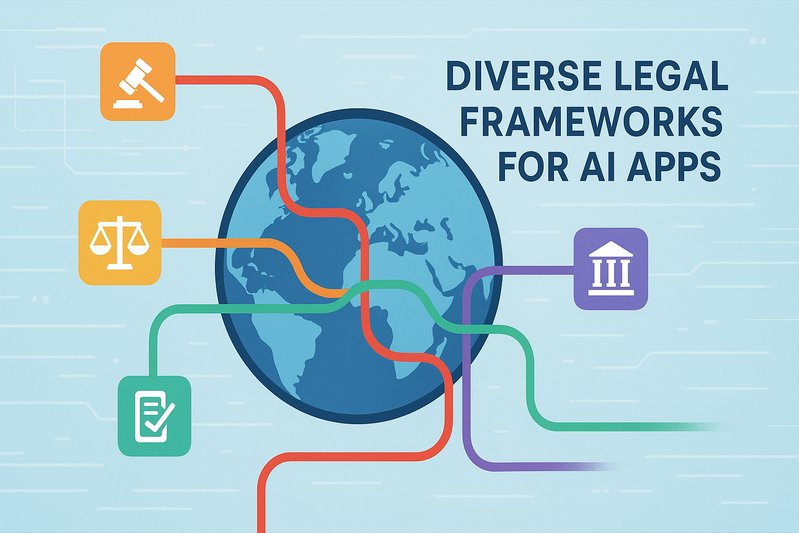
Navigating the Web of Global Legal Compliance for AI Apps
Aligning Your AI App with Intertwined Legal Frameworks Across Key Market Regions
In the rapidly evolving landscape of Artificial Intelligence (AI) applications, remaining compliant with global legal frameworks is both a challenge and a necessity. The digital frontier poses specific regulatory hurdles across different markets, particularly in the United States (US), European Union (EU), United Kingdom (UK), and India. Ensuring that your AI app meets these compliance standards is crucial not only for legal conformity but also for maintaining user trust and upholding the integrity of AI innovations.
Understanding Global Compliance Landscapes
In 2026, a sophisticated reinstatement strategy for an AI app banned from Google Play highlighted the intricate nature of compliance across major international markets. This involves navigating data protection, user interaction policies, and financial regulations that vary significantly across regions but are critical to successfully reinstating an application in prominent digital marketplaces.
United States: Navigating State-Level Laws
In the US, the compliance environment is shaped primarily by the California Consumer Privacy Act (CCPA) and its successor, the California Privacy Rights Act (CPRA), which mandate that businesses provide clear notices at data collection and allow user data deletion requests. These laws are pivotal in ensuring consumer privacy and have set a precedent for other states’ legislation. Moreover, AI applications that potentially interact with children must adhere to the Children’s Online Privacy Protection Act (COPPA), which requires verifiable parental consent and limits data collection from minors ((https://oag.ca.gov/privacy/ccpa), (https://www.ftc.gov/legal-library/browse/rules/childrens-online-privacy-protection-rule-coppa)).
European Union: GDPR and Beyond
In Europe, the General Data Protection Regulation (GDPR) serves as a comprehensive legal framework for data protection and privacy. AI app developers must establish lawful grounds for data processing, secure explicit user consent, and ensure robust data protection measures. Furthermore, the EU is advancing its regulatory regime with the AI Act, which introduces regulations specific to AI systems, enforcing transparency and risk-based obligations ((https://eur-lex.europa.eu/eli/reg/2016/679/oj), (https://artificial-intelligence.europa.eu/ai-act_en)).
United Kingdom: Balancing Between GDPR and Local Regulations
Post-Brexit, the UK mirrors the GDPR principles through its domestic data protection laws. Additionally, the UK’s ICO Children’s Code places specific responsibilities on online services that are likely to be accessed by children. Alongside these, the forthcoming Online Safety Bill mandates proactive measures by platforms to mitigate illegal or harmful content ((https://ico.org.uk/for-organisations/childrens-code/), (https://www.ofcom.org.uk/online-safety)).
India: Emerging Data Protection Policies
With the enactment of the Digital Personal Data Protection Act, 2023, India has taken a significant step towards creating a robust legal framework for digital privacy. This act emphasizes consent-centric data use and confers rights to individuals over their personal data, ensuring a balanced approach to digital governance and data management ((https://www.meity.gov.in/writereaddata/files/DPDP_Act_2023.pdf), (https://www.meity.gov.in/content/it-intermediary-guidelines-and-digital-media-ethics-code-rules-2021)).
Implementing Compliance for AI Apps
To navigate these complex legal landscapes effectively, AI application developers must adopt a comprehensive compliance strategy that is flexible yet precise. Such a strategy must include:
-
Data Safety and Privacy Implementation: Ensuring transparent data practices through the implementation of correct data inventory systems, privacy policy accuracy, and data deletion mechanisms.
-
Age Assurance and Content Moderation: Developing solutions to verify the age of users and moderating user-generated content effectively to protect minors and maintain community standards.
-
Security and Evidence Documentation: Upgrading security features such as network encryption and deployment of incident response strategies to address potential regulatory breaches and security concerns.
Conclusion: Key Takeaways for AI Developers
The regulatory environment for AI applications across the US, EU, UK, and India is dynamic and requires continuous monitoring and adaptation. It’s imperative for AI developers to integrate privacy-by-design principles into their applications while ensuring compliance with region-specific regulations. As technological capabilities expand, so too will the regulatory frameworks governing them. Employing a multi-layered compliance strategy not only mitigates the risk of regulatory penalties but also fosters innovation, builds trust with users, and supports sustained market engagement.
In summary, understanding and aligning with the distinct regulatory frameworks of global markets are crucial for AI applications. By prioritizing legal compliance alongside innovation, developers can navigate the complexities of AI governance more effectively and secure a robust presence in international markets.