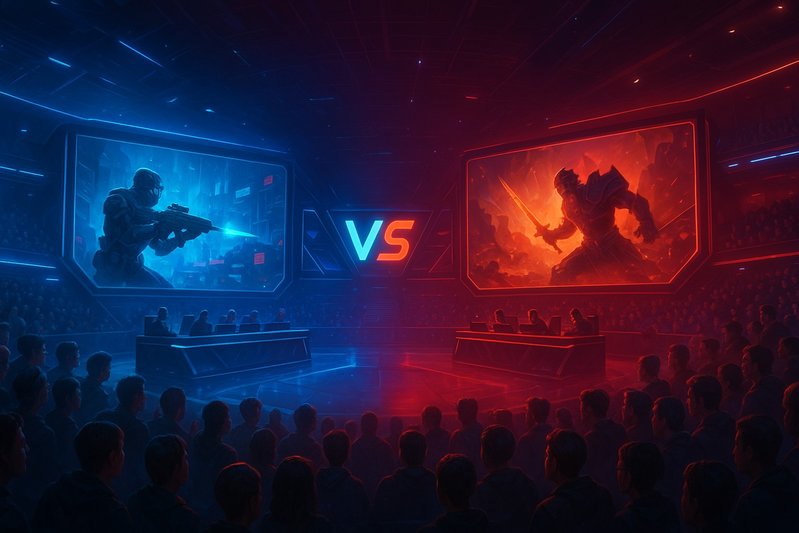
Publisher Control Versus Open Circuits: The Battle for Esports Supremacy
Unpacking the Strategic Approaches of Riot and Valve
In the rapidly evolving world of esports, two models have emerged as dominant forces, shaping the future of this burgeoning industry: highly curated partnership leagues and open circuits. Leading this charge are two titans, Riot Games and Valve Corporation, whose contrasting strategies serve as a pivotal study in balancing control, sustainability, and audience engagement.
The Esports Industry Landscape
As of January 2026, the global esports scene is a culturally potent yet structurally diverse segment of interactive entertainment. The demand for esports continues to soar beyond North America, with Southeast Asia (SEA), the Middle East and North Africa (MENA), and Latin America (LATAM) driving significant growth. This expansion is fueled by mobile-first ecosystems and technological advancements that are reshaping how audiences engage with gaming content.
According to the Global Esports Industry report, Twitch remains the dominant platform for live gaming hours, followed by YouTube Gaming and TikTok Live, which integrate commerce and co-streaming functionalities.
Partnership Leagues: The Riot Approach
Riot Games has established a hallmark in esports with their strategic focus on partnership leagues, particularly in League of Legends (LoL) and Valorant Champions Tour (VCT). This model hinges on stability and collaboration with partners, fostering revenue-sharing opportunities and structured competitive ecosystems.
Advantages and Economic Levers
- Revenue Sharing: Riot leverages its intellectual property (IP) to create revenue-sharing models with items like VCT Team Capsules, wherein 50% of the revenue is shared with partner teams. This aligns the interests of the publisher and teams.
- Co-streaming: Riot embraces broad co-streaming, boosting reach and engaging regional influencers to amplify audience numbers.
- Economic Stability: By providing fixed stipends and sharing revenue from digital items, Riot ensures economic stability for teams, allowing them to focus on sustainability rather than survival.
Open Circuits: Valve’s Decentralized Domain
Valve’s open circuit model, primarily showcased through Counter-Strike 2 (CS2) and Dota 2, embodies flexibility and independence, appealing to event organizers and community-driven content. This model thrives on maximizing reach and innovation without heavy centralized control.
Advantages and Economic Levers
- Lower Fixed Costs: Valve’s approach reduces operational costs by removing rigid league structures, relying on third-party event organizers to manage competitions.
- Digital Item Economy: Revenue from digital items, such as Major stickers, distributes substantial profits directly to teams, with Valve disclosing more than $70 million shared from CS2 Major stickers since 2022.
- Audience Scale: This framework supports a vibrant array of events, from grassroots initiatives to major international tournaments, catering to a diverse audience.
Audience and Regional Dynamics
The global esports audience is not monolithic. It is regionally fragmented, with distinctive trends and preferences. Asia and MENA are leading audience growth, fueled by the mobile dominance in SEA and a youth-centric demographic in MENA.
Twitch, YouTube Gaming, and TikTok Live serve as key platforms, each fulfilling unique roles from live broadcasts to short-form content discovery. Platforms like Huya and DouYu handle substantial domestic consumption in China, though experiencing financial constraints due to regulatory headwinds.
Innovations and Challenges Ahead
Esports is poised at a pivotal moment where technological innovations and global expansion are reshaping its landscape. Co-streaming is redefining content distribution, with companies like Riot and top CS organizers endorsing it to increase content reach.
AI Applications: From real-time performance analytics to anti-cheat systems, AI is transforming production, moderation, and gameplay integrity, addressing issues of fraud and enhancing performance monitoring.
Monetization: Experiments in digital item economies and in-stream commerce provide new revenue avenues. Riot’s successful deployment of esports capsules and integrated shopping experiences on platforms like TikTok Shop exemplify this trend.
Conclusion: Navigating the Future
The battle between publisher-controlled leagues and open circuits now defines the esports arena, dictating strategic decisions that impact revenue models, audience engagement, and content distribution. Riot’s partnership-driven strategy offers security and shared growth potential, while Valve’s open model champions flexibility and creative freedom.
As esports progresses into 2026 and beyond, stakeholders must harmonize these models, leveraging cross-platform integrations and scalably monetized digital economies. Teams that pivot towards sustainable, diversified revenue streams will thrive, ensuring esports’ role as a cultural and economic cornerstone of modern entertainment. The industry’s future will depend on balancing these strategic approaches, weighing risks, and seizing opportunities in this digital age of competition.