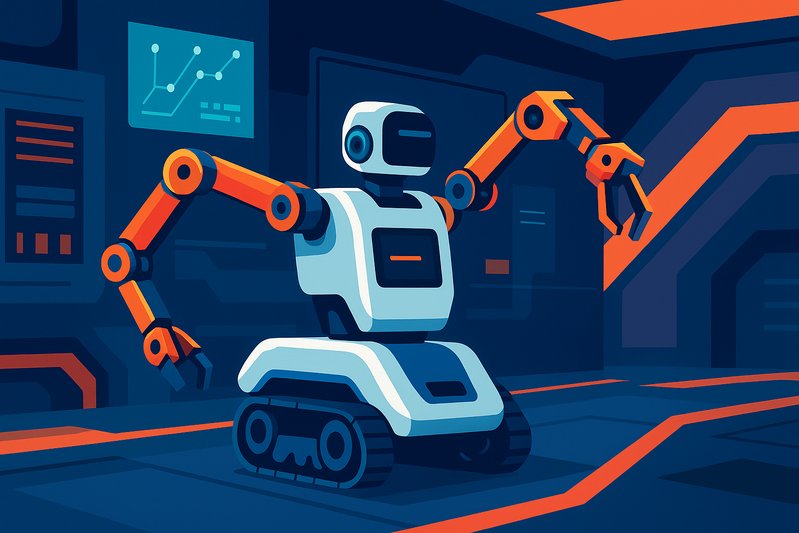
Robots At Your Service: The Rise in Mobile Manipulation
Subtitle: How foundation models and digital twins are transforming industrial robotics
In an era dominated by technological advancement, where robots are no longer just science fiction but a burgeoning reality, mobile manipulation stands out as a crucial frontier. As industries evolve, so do their needs for automation, pushing the envelope for what robotics can achieve. Driven by powerful foundation models and the ingenuity of digital twins, industrial robotics is undergoing a transformative phase with profound implications.
Emergence of Mobile Manipulation
The concept of mobile manipulation refers to robots equipped with high-dexterity manipulators that can perform complex tasks, move autonomously, and interact with their environment. As we look towards 2026 and beyond, this field is rapidly maturing. According to the “Autonomous Systems in 2026” research report, the convergence of multi-modal perception, learned sensor fusion, and simulation technologies have set the stage for significant advancements in mobile manipulation and industrial robotics.
The Role of Foundation Models and Digital Twins
Foundation models, such as the Robotics Transformer 2 (RT-2) and systems like Open-X-Embodiment, are pivotal in driving forward robotics by integrating language-conditioned perception-action models. These models are trained on vast and diverse datasets, enabling them to generalize across tasks and manifestations, exemplified by advances in Vision-Language-Action (VLA) policies. NVIDIA’s Project GR00T stands as a benchmark for cross-platform policy adaptability, essential for the next generation of robotics.
Digital twin technology, notably employed by NVIDIA Isaac Sim, enhances this development. By creating realistic, controlled digital environments to simulate and improve robotic functions before real-world deployment, the gap between simulation (sim) and reality (real) is closing. Digital twins allow for rigorous testing under a variety of scenarios, ensuring robots are ready for complex operational challenges, thus reducing the risk and cost of field deployment.
Real-World Impact and Deployments
The practical application of these advancements is evident across various industries. Agility Robotics’ Digit, for example, is being piloted for tasks like material handling and inspection in structured setting facilities, emphasizing the economic value of reduced cycle times and enhanced uptime metrics. Boston Dynamics has repurposed its next-gen Atlas robot from dynamic acrobatics to tasks emphasizing industrial usability and collaborative safety, showcasing mobile manipulation’s industrial potential.
The broader impact on logistics and manufacturing cannot be overstated. Mobile robots with manipulation capabilities have begun to redefine workflows in these areas, introducing efficiencies and operational benefits that were previously unattainable.
Navigating the Regulatory and Safety Landscape
With innovation comes complexity, particularly in terms of safety and regulation. Implementing these systems within existing frameworks involves navigating intricate safety standards and compliance requirements. Standards like ISO 26262 for functional safety and IEEE 2846 for human behavior assumptions are crucial in map data to ensure that robots not only perform efficiently but also safely within human environments.
The regulatory scene is adjusting to this wave of change. As U.S. and European bodies scale their oversight of autonomous systems, including the FAA’s BVLOS rules and EASA’s U-space framework for drones, robots in industrial applications are subject to similarly stringent scrutiny regarding safety and operational transparency.
Future Looking: Challenges and Opportunities
Despite significant progress, challenges remain. Achieving statistically significant safety benchmarks in open-world scenarios, addressing liability issues, and overcoming cyber-physical security threats continue to hinder widespread adoption. Furthermore, ensuring that robots remain environmentally conscious throughout their lifecycle, from energy usage to component manufacturing, poses an ongoing challenge.
However, the opportunities are vast. As mobile manipulation continues to mature, it promises increased efficiencies and capabilities across sectors—from automation in complex assembly lines to seamless integration into smart warehouses and beyond.
Conclusion
The rise of mobile manipulation marks a pivotal point in industrial robotics. Driven by the synergy of foundation models and digital twins, this transformation offers industries an opportunity to revolutionize their operations, align with safety and compliance, and address global demand for smarter, more adaptable technology. As these robots continue to develop, industries must remain vigilant and strategic in approaching both the challenges and the immense potential of this technology in the years to come.
In conclusion, the future looks promising for mobile manipulation. As foundational technologies evolve and regulatory structures catch up, we stand on the brink of a new era in industrial robotics—one characterized by increased intelligence, flexibility, and safety.