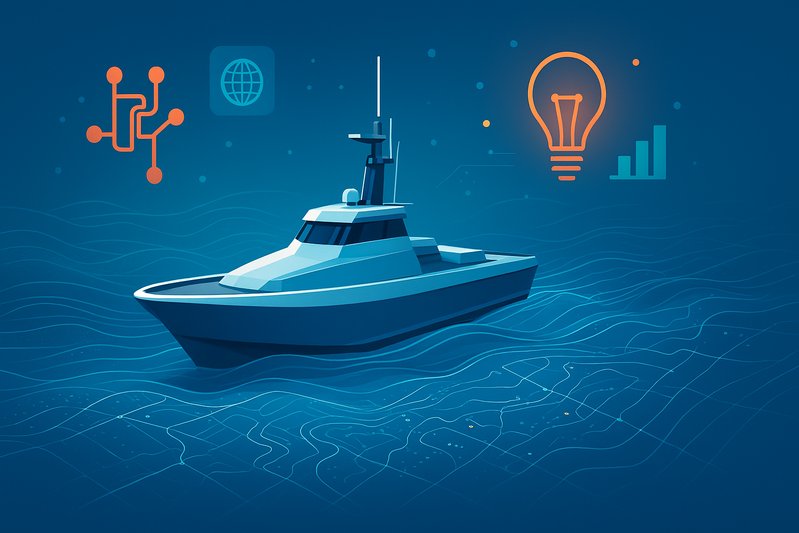
Sailing Forward: Innovations and Regulations in Maritime Autonomy
Unmanned Vessels and the New Frontier of Maritime Operations
As we step into a new era of technological innovation, the world is witnessing transformative changes across various domains. Maritime autonomy, a sector often overshadowed by advancements in road vehicles and drones, is now steering into the spotlight. Powered by cutting-edge technologies and emerging regulatory frameworks, unmanned vessels are navigating uncharted waters, promising enhanced efficiency and safety in maritime operations.
The State of Maritime Autonomy
In the realm of maritime operations, autonomous systems have made significant strides. By 2025, the International Maritime Organization (IMO) had made headway with the Maritime Autonomous Surface Ships (MASS) initiative, highlighting non-mandatory regulations with an eye on a compulsory code aligning with the Safety of Life at Sea (SOLAS) conventions. This regulatory progress paves the way for harmonizing global operations, addressing key factors such as flag-state and port-state controls, technical baselines for autonomous systems, and regulatory watchkeeping requirements.
Leading the commercial front are persistent uncrewed surface vehicles (USVs) like Saildrone, which have revolutionized oceanic data collection tasks. With capabilities that stretch over weeks and even months, fleets like Saildrone are able to deliver critical data on weather, climate, and maritime awareness with significant cost reductions compared to traditional crewed missions. Similarly, advancements from companies like Sea Machines show promise in navigation and collision avoidance technologies, especially in contexts like tugs, workboats, and harbor operations.
Technological Enablers
Multimodal Perception and Sensor Fusion
Fundamental to the successful deployment of autonomous vessels is the integration of robust multimodal perception systems, which blend data from radar, Automated Identification Systems (AIS), and vision-based sensors. These systems enhance real-time navigation and enable efficient collision avoidance, pivotal for the autonomy of vessels operating in complex maritime environments.
Mapping, Localization, and Simulation
Self-updating maps and advanced simulation tools such as digital twins have become indispensable, ensuring operational stability and rigorously testing autonomy stacks in simulated real-world conditions. Such innovations significantly cut down the risk of operational failures, as they allow for extensive testing of rare events and scenarios difficult to replicate in the physical realm.
Regulatory Landscape
The evolution of maritime autonomy is closely tied to regulatory developments. The IMO’s MASS Code, although currently non-mandatory, provides a blueprint for future regulatory frameworks. This global effort aims to synchronize disparate national regulations, which is crucial for international waters navigation and operational consistency.
In addition, current maritime practices are heavily influenced by compliance with protocols like the International Regulations for Preventing Collisions at Sea (COLREGs). Autonomous systems need to demonstrate adherence to these norms to assure public trust and safety. This challenge calls for rigorous validation and continuous improvement of autonomy algorithms to ensure that autonomous vessels can safely navigate crowded and complex waterways.
Real-World Deployments and Business Impact
Crucially, commercial deployments in maritime autonomy are already contributing significant business value. For instance, the operational endurance of USVs like Saildrone demonstrates the economic viability of maritime data operations without a crew, thus drastically reducing operational costs and expanding the potential for oceanographic research and maritime security applications.
Furthermore, autonomy-assist systems are transforming sector-specific operations. The integration of autonomous navigation aids in tugs and workboats has resulted in tangible safety and operational efficiency improvements, serving as stepping stones toward fuller autonomy in more complex shipping environments.
Key Challenges and Future Directions
Despite the clear benefits, several challenges must be addressed for broader adoption of maritime autonomy. One paramount challenge is ensuring statistically significant safety improvements over human-operated benchmarks, particularly in unpredictable open-world conditions. This requires continual advancement in machine learning lifecycle assurance, cyber-physical security, and the reduction of energy and environmental footprints.
The coming decade will likely see concentrated adoption of maritime autonomous systems in clearly defined operational domains where the return on investment is evident and governance is well-established. These include freight corridors, facility inspections, and dedicated surveillance or research missions with lower operational complexities.
Conclusion: Navigating to the Horizon
Maritime autonomy is set to redefine the boundaries of marine operations, driven by groundbreaking technologies and emerging international standards. As regulatory environments continue to evolve alongside technological innovations, the scope for unmanned vessels is vast, with potential applications ranging from commercial shipping to environmental monitoring and beyond.
A future where maritime autonomy is a standard, not an exception, requires continued collaboration between technologists, regulators, and industry players. The journey forward holds immense promise and, perhaps inevitably, a sea change in how the world’s waterways are traversed. Embracing this transformation today ensures a more efficient, safer maritime industry for tomorrow.