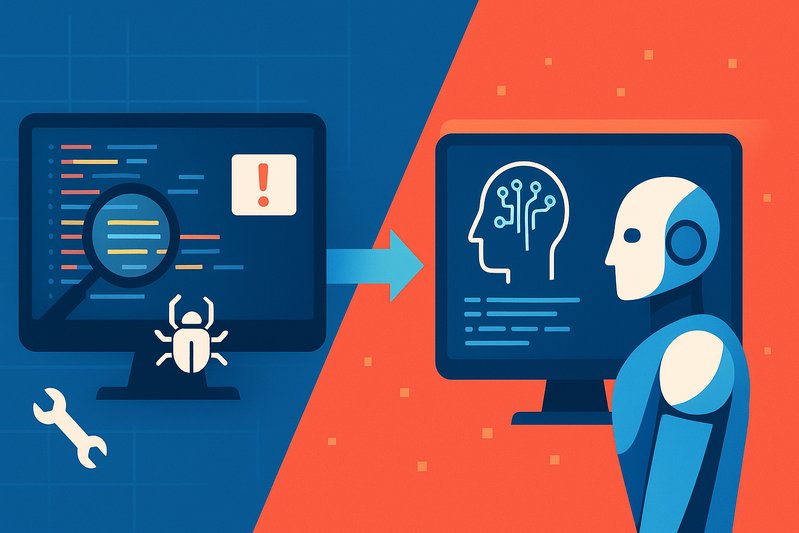
The Evolution of Debugging: From Manual to Semi-Autonomous Systems
Tracing the Journey from Traditional Manual Debugging to Claude Code’s Semi-Autonomous Loop
Debugging has long been a cornerstone in software development, embodying the blend of art and science necessary to sift through code and unearth its flaws. Historically, this process relied heavily on manual effort, demanding deep expertise and significant time from developers. However, as codebases expand and software complexity multiplies, traditional approaches are being augmented by new, semi-autonomous systems such as Claude Code, promising to redefine how bugs are discovered and addressed.
The Roots of Manual Debugging
Before the advent of AI-driven tools, debugging was intensely manual. Developers used integrated development environment (IDE) debuggers, tracing through code line by line. Tools like VS Code, IntelliJ, and Visual Studio enabled developers to set breakpoints, inspect variables, and step through execution processes, providing precise control over the debugging task ((https://code.visualstudio.com/docs/editor/debugging), (https://www.jetbrains.com/help/idea/debugger-basics.html), (https://learn.microsoft.com/en-us/visualstudio/debugger/debugger-feature-tour?view=vs-2022)). These tools excel at offering detailed insights into program execution but require meticulous effort and expertise.
Static analyzers and linters such as SonarQube, ESLint, and Pylint assist by enforcing coding standards and detecting potential issues before runtime ((https://docs.sonarsource.com/sonarqube/latest/), (https://eslint.org/docs/latest/use/), (https://pylint.readthedocs.io/en/stable/)). These tools provide deterministic and consistent outputs, vital for maintaining code quality but fall short in addressing the dynamic and nuanced nature of many bugs.
Enter Claude Code: Semi-Autonomous Debugging
The evolution towards semi-autonomous debugging represents a fundamental shift in how developers approach bug resolution. Claude Code exemplifies this change by integrating large language models (LLMs) to extend debugging beyond diagnostics into proactive problem-solving. This tool transforms debugging into a repository-aware experience capable of localizing faults, suggesting patches, and running tests both autonomously and iteratively ((https://www.anthropic.com/news/claude-code), (https://www.anthropic.com/news/claude-3-5-sonnet)).
Claude Code operates as a conversational agent within IDEs, reading entire codebases to propose changes and even generate commit narratives and test plans. Its prowess in dealing with complex algorithms and multi-file reasoning positions it as a powerful ally for modern developers ((https://www.anthropic.com/news/claude-code)).
Comparative Performance on Benchmarks
The benefits of Claude Code become evident when measured against established benchmarks like SWE-bench, which evaluate the ability to autonomously resolve bugs documented as real GitHub issues. Claude Code’s AI-driven end-to-end repair capability is uniquely validated on these benchmarks, showcasing a measurable success rate where traditional tools are not designed to compete ((https://github.com/princeton-nlp/SWE-bench), (https://arxiv.org/abs/2310.06770)).
In contrast, curated datasets such as Defects4J, BugsInPy, and QuixBugs involve traditional static approaches that lack the autonomous patch generation characterizing modern tools ((https://github.com/rjust/defects4j), (https://github.com/squaresLab/BugsInPy), (https://github.com/jkoppel/QuixBugs)). These datasets are foundational in validating bug-fixes but often require additional manual evaluation, providing a complementary rather than competing capability for Claude Code.
The Hybrid Approach: Best of Both Worlds
The optimal debugging strategy in 2026 leverages both Claude Code’s semi-autonomous capacities and traditional tools’ deterministic strengths. In typical workflow settings, confidence in bug resolution and decreased time-to-fix are achieved by first applying robust traditional practices for fault localization and then employing Claude Code to draft and validate patches. Benchmarks show that AI suggestions significantly reduce manual effort and foster a smoother workflow, with studies indicating improved developer satisfaction and productivity ((https://github.blog/2022-09-07-research-quantifying-github-copilots-impact-on-developer-productivity), (https://survey.stackoverflow.co/2024/), (https://www.jetbrains.com/lp/devecosystem-2024/)).
Security and Compliance: Trusting the Autonomy
With automation comes the critical need for security and compliance controls. Anthropic’s Claude Code operates under strict privacy guidelines, ensuring that customer data remains protected and usage is transparent ((https://docs.anthropic.com/claude/docs/data-usage-and-privacy), (https://www.anthropic.com/trust)). For organizations, this means maintaining rigorous version control and governance frameworks to mitigate risks associated with AI-driven modifications.
Conclusion: The Future of Debugging
The transition to semi-autonomous debugging systems like Claude Code represents a meaningful advancement in software development, offering significant improvements in efficiency, accuracy, and developer satisfaction. While traditional debugging tools remain invaluable, tools like Claude Code eliminate bottlenecks and free developers to focus on higher-order tasks. Thus, the future of debugging is not merely automated but intelligently augmented, combining the precision of traditional methods with the foresight of AI-driven augmentation.
In an era characterized by increasing software complexity, leveraging a hybrid model for debugging ensures robustness, aligning with best practices and organizational needs for both innovation and stability. The synergy between human expertise and automated intelligence marks the dawn of a new, more efficient software development lifecycle.