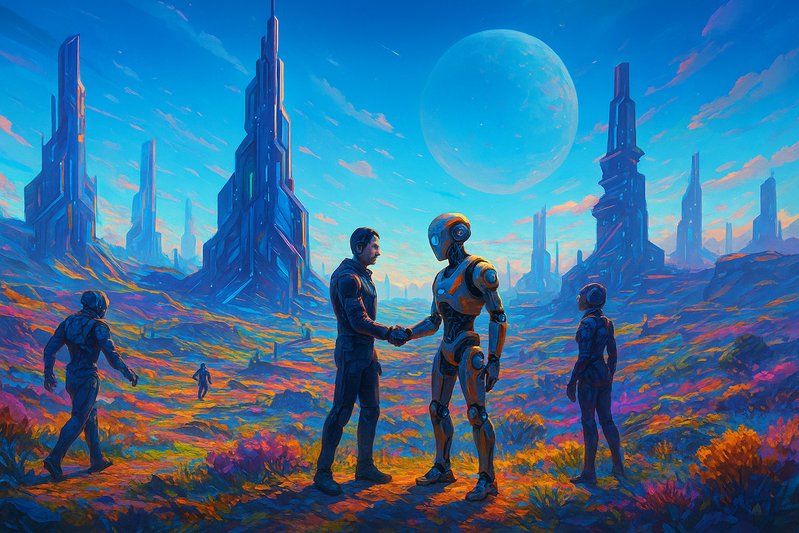
The Role of AI and Procedural Generation in Sci-Fi Gaming
How AI-Driven NPCs and Procedural Worlds Transform Play Experiences
In the ever-evolving realm of science fiction gaming, technology continues to break boundaries, offering players experiences once deemed purely fantastical. By 2026, advancements in AI and procedural generation are poised to redefine how gamers interact with virtual worlds, enabling deeper immersion and unprecedented dynamism. As these technologies progress, their impact on sci-fi game design becomes increasingly pronounced, bringing about a new era where player experiences are as expansive as the universes they explore.
The Genesis of New Worlds: Game Engines and Procedural Generation
At the heart of these transformative experiences are powerful game engines such as Unreal Engine 5.x, Unity 6, and Godot 4. Each of these platforms brings unique capabilities to the table that significantly enhance sci-fi gaming.
Unreal Engine 5.x stands out for its ability to craft expansive, cinematic worlds. With features like Nanite virtualized geometry and Lumen for global illumination, developers can build environments of immense scale and detail, from the hulls of starships to entire megastructures. These tools eliminate the need for traditional level-of-detail authoring, a boon for developers focused on creating intricate, vast sci-fi landscapes.
Procedural generation is another critical pillar in the creation of these worlds. Systems like Unreal Engine’s Procedural Content Generation Framework and Houdini Engine allow developers to create highly detailed environments—like asteroid belts or space stations—at a fraction of the traditional manual effort. These systems enable the rapid creation and deployment of complex structures and natural landscapes, ensuring that each player’s journey is unique.
AI-Powered Narratives: NPCs and Interaction
AI technologies are rapidly evolving beyond simple scripted interactions, introducing NPCs capable of dynamic and more natural interactions. The evolution is driven by AI frameworks like NVIDIA’s ACE for Games, Inworld, and Convai. These platforms are pioneering conversational AI in games, allowing NPCs to engage in nuanced and context-aware dialogues with players.
The transition towards AI-driven characters is marked by a shift from pre-programmed responses to real-time, adaptive conversation models, which include automatic speech recognition and response synthesis. This level of sophistication enables a richness in player-NPC interactions previously unattainable, allowing for more intricate storytelling and personalized player experiences.
Hardware Prowess: Rendering and Simulation
The demands of rendering vast sci-fi worlds and simulating realistic interactions are met by cutting-edge hardware and software technologies. DirectX 12 Ultimate, Vulkan, and Metal 3 represent the forefront of graphics APIs, each facilitating high-performance rendering required for real-time ray tracing and complex visual effects.
For example, hybrid ray/path tracing used in titles like Cyberpunk 2077 RT Overdrive and Alan Wake 2 showcases cinematic quality achievable on modern hardware when paired with advanced temporal upscaling technologies like NVIDIA’s DLSS and AMD’s FidelityFX Super Resolution 3. These techniques are instrumental in rendering neon-drenched cities or the interior of vast starships that are now emblematic of futuristic settings in gaming.
Beyond the Horizon: AI and Procedural Synergy
The union of AI with procedural generation offers transformative potential in sci-fi gaming. Unity’s DOTS framework, combined with Havok Physics, exemplifies how large-scale simulations of entities like drone swarms or city populations can be managed efficiently. By embracing deterministic AI models like behavior trees and navmeshes alongside generative AI tools, the creation of both predictable and serendipitous in-game experiences becomes feasible.
Recommendations for Developers
For developers targeting space opera-like experiences with seamless planetary-to-space transitions, Unreal Engine 5.x is indispensable due to its cinematic giant-scale rendering capabilities. Meanwhile, Unity 6 shines in the execution of large-scale simulations, making it ideal for hard sci-fi that involves complex physics and extensive agent-based systems.
Moreover, the standardized adoption of frameworks like OpenUSD and MaterialX ensures that development pipelines remain interoperable and future-proof against evolving platform requirements.
Conclusion
The intersection of AI and procedural generation with advanced gaming technologies heralds a new frontier for science fiction games, one where player agency and world-building interactivity redefine the genre itself. By aligning their strategies with the capabilities of modern engines and AI frameworks, developers can create engaging, believable worlds and narratives. This alignment will not only elevate the gaming experience but also ensure longer-term viability and engagement, thus shaping the trajectory of sci-fi gaming into the future.
In summary, as these technologies grow and integrate into gaming infrastructure, the boundaries of science fiction in games expand, allowing players to step deeper into immersive and vibrant universes where the only limit is imagination.