Transformative Technologies in Game Streaming: A Strategic Overview for 2024-2026
Introduction
As we step into the mid-2020s, game streaming is experiencing a significant transformation driven by advancements in technology. This article provides a strategic overview of the game streaming landscape from 2024 to 2026, focusing on live streaming and cloud gaming. We will explore the architectures, technological shifts, and market dynamics that define this period, providing an insightful roadmap for stakeholders.
The Game Streaming Ecosystem
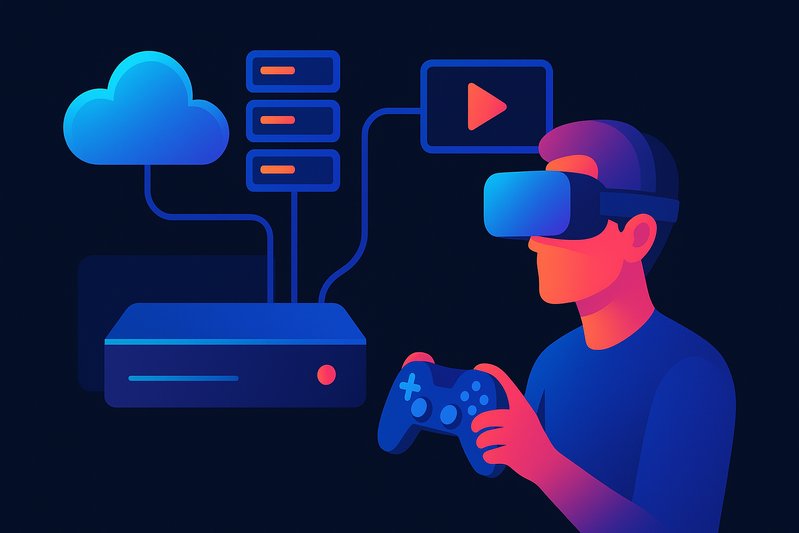
Game streaming can be divided into two primary segments: live game streaming and cloud gaming. Live game streaming involves broadcasting gameplay to an audience, utilizing a range of technologies from creator tools to cloud-based encoding and content delivery networks (CDNs). On the other hand, cloud gaming delivers interactive gaming experiences rendered on GPU servers with player inputs driving the gameplay in real-time, achieving low latency essential for smooth player experiences [1][2][3].
Market Architecture and Latency Challenges
Two dominant architectures dictate the game streaming landscape. HTTP-based low-latency adaptive bitrate (ABR) streaming, such as LL-HLS and LL-DASH, aims to balance low latency with scale and efficiency, supporting millions of concurrent users with a latency target of 1-3 seconds [12][13]. Meanwhile, WebRTC architectures, employing SFU-based topologies, achieve sub-200 ms latency, crucial for interactive and real-time applications like cloud gaming and co-streaming [14][15][16].
Codec and Capture Technology
The efficiency and quality of game streaming heavily rely on codecs. AVC/H.264 remains widely used, but newer codecs like HEVC/H.265 and AV1 are gaining traction due to their superior compression capabilities and support for high-resolution streams. AV1, for instance, offers significant bitrate savings, now supported across major browsers and hardware, making it viable for both WebRTC and real-time streaming workflows [4][6][7][8]. Key tools such as OBS Studio and GStreamer dominate the software scene, providing robust solutions for capture and encoding in streaming workflows [1][3].
Delivery and Interactivity
For content delivery, CDNs like Akamai and Cloudflare are essential components, enabling the efficient dissemination of live streams across the globe. These infrastructures support the demands of time-sensitive game streams, banking on technologies such as QUIC for reduced latency and secure data transmission [17][18]. In terms of interactivity, platforms like Twitch and YouTube are at the forefront. Twitch’s low-latency modes and APIs enhance viewer engagement and integration with multiple monetization strategies [50][51][54].
Platforms and Monetization
Key players like NVIDIA GeForce NOW and Xbox Cloud Gaming are revolutionizing cloud gaming with extensive GPU fleets and agile networks, delivering seamless gaming experiences across multiple devices [62][63]. Monetization strategies in these platforms include subscriptions, in-game purchases, and advertising, which have been effectively integrated to support creator frameworks such as Streamlabs and StreamElements [50][53][70][71].
AI and Machine Learning Integration
AI and machine learning are becoming key components in enhancing game streaming. Technologies such as NVIDIA Maxine are used for real-time noise suppression and video super resolution, crucial for maintaining high-quality streams at lower bitrates [78][79]. Machine learning also aids in automating content moderation, a significant aspect for platforms to maintain community standards [86].
Conclusion
The game streaming industry is poised for continued growth and innovation as it marches towards 2026. With advancements in real-time codecs like AV1, low-latency ABR, and the integration of AI technologies, streaming platforms are delivering richer, seamless experiences. These transformations not only enhance player experiences but also offer new monetization avenues for creators and developers. As the landscape adapts to these technological shifts, stakeholders must navigate this evolution strategically, balancing technology adoption with user engagement and business objectives.
Sources
- OBS Studio: OBS Studio is pivotal in live streaming as the leading creator tool for capturing and encoding gameplay.
- FFmpeg: FFmpeg is foundational for video processing tasks, crucial for live streaming workflows.
- GStreamer: GStreamer provides modular pipelines, key for building custom low-latency workflows in streaming.
- Alliance for Open Media (AV1): AV1 codec relevance is highlighted by its efficiency in bitrate savings and growing hardware support.
- NVIDIA Video Codec SDK (NVENC/NVDEC): NVIDIA’s optimization strategies for real-time encoding align with enhanced streaming capabilities.
- AMD Advanced Media Framework (AMF): AMD AMF provides crucial support for efficient video encoding in both H.264 and newer codecs like AV1.
- Intel oneVPL (Quick Sync): Intel’s Quick Sync technology offers valuable GPU-accelerated processing for real-time game streams.
- Apple – Low-Latency HLS: Low-Latency HLS mitigates latency concerns in live streaming, supporting broader scale.
- DASH-IF – Guidelines for Low-Latency Live Streaming: Provides standards for low-latency DASH, essential for broad compatibility and scalability.
- IETF – WHIP (WebRTC-HTTP Ingestion Protocol): WHIP standardizes WebRTC ingestion, facilitating interoperability in streaming.
- IETF – WHEP (WebRTC-HTTP Egress Protocol): WHEP provides protocols for WebRTC stream delivery, enhancing egress capabilities.
- RFC 8825 – Overview of WebRTC: Establishes WebRTC’s foundational role in low-latency, interactive streaming.
- RFC 9000 – QUIC: QUIC facilitates rapid, low-latency communications, imperative in streaming protocols.
- W3C – WebTransport: WebTransport is explored for low-latency data transport, advantageous for future interactive streaming.
- Twitch – Low Latency Video: Highlights Twitch’s adoption of low-latency technologies, enhancing viewer engagement.
- Twitch API: API allows for integration and expansion of Twitch’s streaming functionalities.
- YouTube Live Streaming API: Facilitates YouTube’s streaming services, integrating accessible live broadcast capabilities.
- YouTube – Live stream settings (latency): Outlines latency settings crucial for optimizing live stream quality and reach.
- NVIDIA GeForce NOW: GeForce NOW exemplifies cloud gaming success powered by extensive GPU use.
- Xbox Cloud Gaming: Demonstrates seamless cloud gaming experience, enhancing player engagement.
- Streamlabs: Provides tools for monetizing live streams through alerts, and integrations.
- StreamElements: Offers powerful tools for integrating monetization functionalities into gaming streams.
- NVIDIA Maxine (AI Video/Audio Effects): Demonstrates AI use in enhancing video quality through real-time effects.
- NVIDIA RTX Video Super Resolution: Exemplifies advancements in AI for video quality enhancement.
- Hive Moderation: Showcases AI’s role in maintaining community standards through automated moderation solutions.